
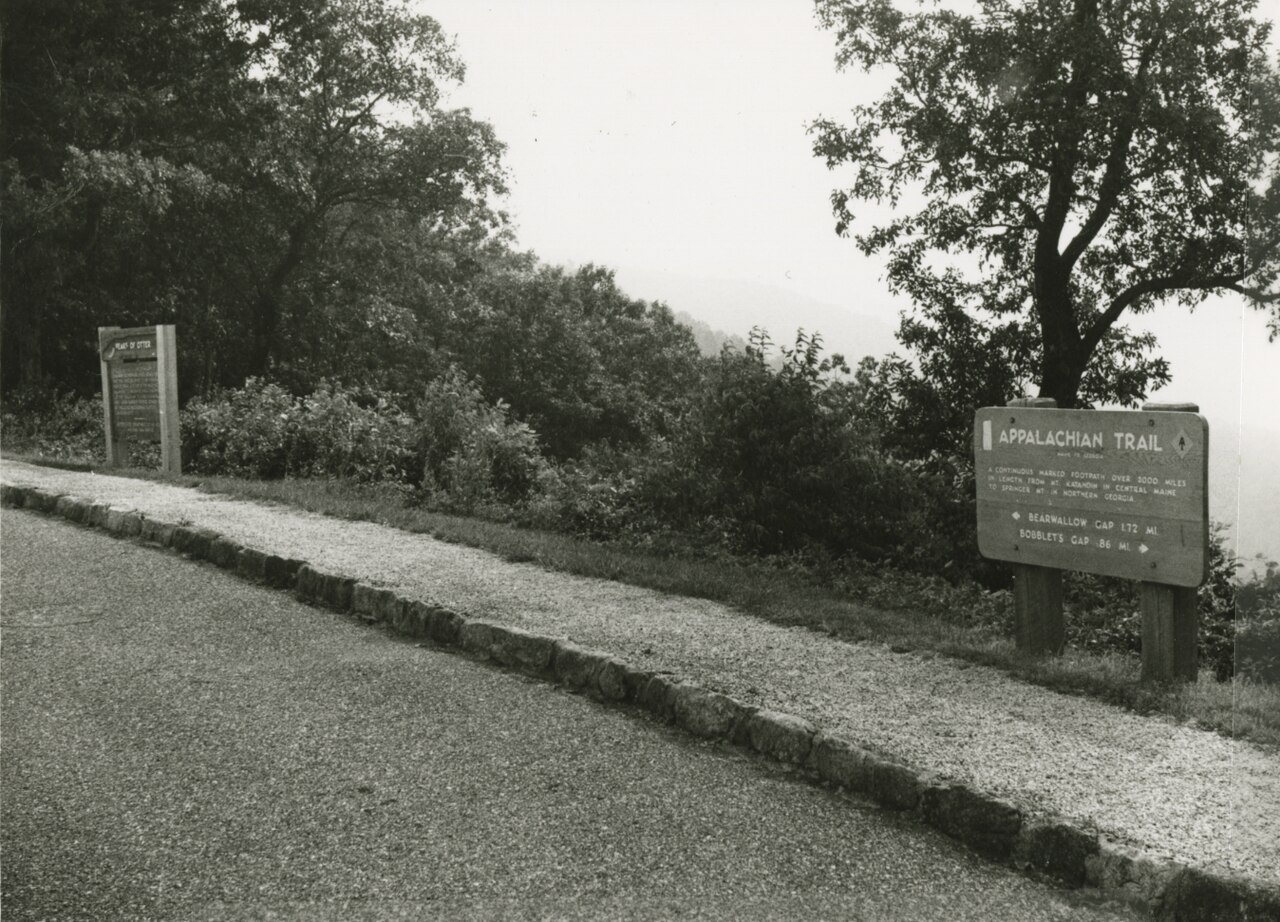
Appalachian Trail crossing sign near Milepost 92 on the Blue Ridge Parkway, photographed Aug. 1, 1976. National Park Service, public domain.
The Appalachian Trail is built on movement.
Hikers arrive at shelters carrying everything they need on their backs. They share meals with strangers, trade stories along the trail, and, by morning, disappear into the woods again.
In May 1981, Robert Mountford Jr. and Laura Susan Ramsay were doing exactly that.
The two 27-year-old social workers from Ellsworth, Maine, were hiking through Virginia as part of a fundraising trip for a Maine school that served children with intellectual disabilities. Mountford’s mother operated the school. [1][2]
Neither knew that their journey would end near a shelter in Giles County, or that their deaths would become one of the most disturbing cases in the history of the Appalachian Trail. [1][2]
On May 19, Mountford and Ramsay were near Dismal Creek in Giles County, trying to reach Wapiti Shelter. [2]
However, there was a problem with finding the shelter.
Two shelters in the area were known by similar names. The older Wapiti Shelter sat along a side trail near a road and had become a gathering place for some residents. A newer shelter, built the year before the Appalachian Trail was relocated, stood farther along the trail. [2]
Mountford had apparently written that he could not find the older shelter and would camp elsewhere if he could not locate the newer one.
Eventually, the couple reached the newer shelter. [2]
They were not alone.
A local man named Randall Lee Smith, 27, encountered Mountford and Ramsay near the shelter. Smith lived nearby in Pearisburg and was unemployed at the time. He was familiar with the surrounding mountains.
Witnesses later reported seeing Smith with the couple near the shelter. [1][2]
Sometime that night, the encounter turned deadly.
Mountford was shot three times in the head.
Ramsay suffered more than a dozen stab wounds, along with injuries caused by a piece of iron and a long nail.
Their bodies were removed from the shelter and buried separately beneath leaves and forest debris, about 75 yards from the shelter. [1][2]
For several days, no one knew where the couple was.
Mountford and Ramsay had been expected to meet another hiker near Pearisburg.
They never arrived.
Concern grew, and a search began.
Investigators eventually learned that other hikers had seen the couple with a peculiar-looking man near Wapiti Shelter. The sighting gave investigators their first significant lead. [1][2]
Eleven days after Mountford and Ramsay were last seen, investigators returned to the shelter.
It was May 30.
Giles County Deputy Tom Lawson noticed something unusual beneath the shelter’s floorboards. A reddish substance appeared to be caught between them.
Lawson pushed a knife between the boards.
It appeared to be blood.
Laboratory analysis later determined that the blood belonged to Mountford.
Investigators searched the area surrounding the shelter. Nearby, they found a mound of leaves that appeared to have been deliberately placed.
Beneath it was Ramsay’s body, still inside a sleeping bag. [1][2]
The following day, investigators returned with a cadaver dog.
The dog led them several hundred yards from the shelter towards a stump. When investigators dug at the location, they discovered Mountford’s body, also buried in a sleeping bag. [1]
The scene provided investigators with another important clue.
Ramsay’s backpack had been recovered.
Inside was a paperback novel she had been reading: Mountolive by Lawrence Durrell.
The book contained a bloody fingerprint.
Investigators compared the print with fingerprints already on file and determined that it belonged to Randall Lee Smith. His fingerprints were available because of his previous work in the Norfolk Shipyards. [1]
Smith quickly became the primary suspect.
Investigators searched the home Smith shared with his mother in Pearisburg. Inside, they found blood-stained clothing belonging to Mountford and Ramsay. [1]
They also found a handwritten note in Smith’s writing. In it, Smith claimed that he had been kidnapped by two people who intended to kill him.
Investigators did not believe the story. [1]
But Smith was already gone.
He fled Virginia and eventually abandoned his pickup truck in Myrtle Beach, South Carolina. [1][2]
Inside the truck was another disturbing note.
The note referred to a “boy and girl” and said they had been nice to him, but that it would be a shame when the time came to “get rid of them.” It also indicated that Smith expected ot be far away before the truck and the people involved were found. [1][3]
The note was not a confession in the legal sense.
But combined with the fingerprint, blood evidence, and belongings found at Smith’s home, it became another significant piece of evidence against him. [1]
Smith was eventually arrested in Myrtle Beach.
When authorities encountered him, Smith claimed he had amnesia. He said he did not know his name or how he had gotten to South Carolina.
Investigators later obtained medical consent to get him to write his name.
He wrote:
Randall Lee Smith. [1] Smith was charged with the murders of Mountford and Ramsay.
The case never went through a full trial.
In March 1982, Smith pleaded guilty to two counts of second-degree murder. He received two concurrent 15-year sentences, meaning the sentences were served at the same time. [3]
Because the sentence ran concurrently, Smith could eventually leave prison after serving approximately 15 years. His release became a source of anger among the victims’ families and among the public. [3]
The Appalachian Trail Conference, as the organization was then known, publicly criticized the fact that Smith would eventually have the opportunity to leave prison.
In 1996, Smith was released after serving his sentence.
He returned to Pearisburg, where he lived with his mother.
He was placed under supervised parole and wore an electronic monitoring device.
His mother died in 2000.
Afterward, Smith continued living in the family home and became increasingly isolated. There is comparatively little publicly documented information about his life between 2000 and 2008. Contemporary reporting described him as a recluse who generally kept to himself. [1]
His parole supervision ended in 2006. [3]
Two years later, Smith disappeared from Pearisburg.
And once again, he went into the mountains.
In early 2008, Smith left his home and went into the woods.
He took camping and fishing equipment with him, along with his dog, Bo.
Neighbors eventually became concerned when he failed to return, and authorities began searching for him. [1][4]
Then, on May 6, 2008, Smith encountered two fishermen, Scott Johnston and Sean Farmer, while they were camping in the Brushy Mountain area of Giles County. [1][5]
The encounter began peacefully.
Smith approached their campsite, and the men shared food with him.
They had no reason to believe they were sitting with a convicted double murderer.
Then Smith pulled out a .22-caliber handgun and opened fire.
Farmer was shot in the temple and chest. Johnston was shot in the neck and the back. [1][5]
Despite their injuries, both men survived. [1][4]
Farmer reached Johnston’s truck, and the two managed to flee the area and find help.
Their survival ultimately led police back to Smith.
The attack was particularly disturbing because it happened only 1.5 miles from the location of the 1981 murders. [1]
Smith fled in Johnston’s pickup truck.
A Virginia State Police trooper later spotted the vehicle and pursued it. Smith lost control of the truck, which crashed and overturned. A .22-caliber handgun was found near him. [1][5]
He was taken to Carilion Roanoke Memorial Hospital and later transferred to the New River Valley Regional Jail. [5]
Smith never made it to trial.
On May 10, 2008, just days after the shooting, he was found unresponsive in his jail cell and died. [5]
An autopsy determined that he died from a blood clot in his lung caused by complications from injuries he suffered in the crash.
The two men he shot survived. [1][5]
Smith had served 15 years for killing two people in the Dismal Creek area.
Nearly three decades later, he returned to the same general region and attacked two more people.
Why?
Was the location significant to him?
Was it simply familiar territory?
Did he feel comfortable in those mountains?
Or was his return somehow connected to what happened in 1981?
We don’t know.
And we never will.
Several people who later examined Smith’s life wondered whether the mountains themselves held some significance for him. But those explanations remain theories, not facts. Contemporary reporting noted that investigators and psychologists could not establish a definitive motive for the 1981 murders.
Smith died before the 2008 case could go to trial and before anyone could get a definitive answer from him about why he had returned.
The Appalachian Trail continued.
Hikers continued walking through the mountains, passing shelters and following the white blazes that mark the trail.
But somewhere near Wapiti Shelter, the trail still carries the memory of what happened there.
The mountains kept the answer.
[1] Wil Haygood, The Washington Post, “Blood on the Mountain,” July 7, 2008. This is the most comprehensive source for the investigation, evidence, Smith’s background, the 1981 murders, his 1996 release, and the beginning of the 2008 attack. https://www.washingtonpost.com/archive/style/2008/07/08/blood-on-the-mountain/c5012ce9-aa97-4c92-9cdb-16f1babe4e5c/
[2] The Washington Post, “Police Look for Bearded Man as Fear Grows on Appalachian Trail,” June 4, 1981. Contemporary reporting covering the 1981 murders, the Wapiti Shelter, the trail relocation, the missing hikers, and the discovery of their bodies. https://www.washingtonpost.com/archive/local/1981/06/04/police-look-for-bearded-man-as-fear-grows-on-appalachian-trail/2112841d-e9af-47bf-939b-b3f8a3f6515b/
[3] Lisa K. Garcia, The Roanoke Times, “Hikers’ Killer Going Home: Smith to Be Free After 15 Years Behind Bars,” Sept. 26, 1996. Contemporary reporting on Smith’s conviction, plea agreement, sentence, release and parole. https://scholar.lib.vt.edu/VA-news/ROA-Times/issues/1996/rt9609/960926/09260065.htm
[4] WDBJ-7, May 8, 2008 broadcast archive. Contemporary reporting on the shooting of Scott Johnston and Sean Farmer, including their encounter with Smith and their escape. https://scholar.lib.vt.edu/VA-news/WDBJ-7/script_archives/08/0508/050808/050808.m.htm?utm_source=chatgpt.com
[5] Wil Haygood, The Washington Post, “Death of Suspect in Custody Is Traced to Road Accident,” Aug. 7, 2008. Contemporary reporting on Smith’s death, the 2008 shooting and the autopsy findings. https://www.washingtonpost.com/archive/local/2008/08/08/death-of-suspect-in-custody-is-traced-to-road-accident/e35e5e1d-014e-4048-bd6f-333ca91d3869/